~/beecheycontact
Lead AI Engineer @ TransHumanity

Dr Matthew Beechey

> machine learning engineer, researcher and product manager

I build machine learning systems that have to survive contact with the real world — multi-agent AI for transport authorities, graph neural networks for beyond-5G networks, and embedded sensor suites on public buses.

PhD
ML for network security
2
journal papers
10+
years building & researching
evidential_classifier.py — live
Decision boundary with an uncertainty bandP(class)feature xᵢ
class Aclass Bdeclined — uncertainty exceeds threshold

fig. 1 → A classifier that can decline. Points in the dashed band carry more epistemic uncertainty than the threshold allows, so an evidential model refuses them rather than guessing — the mechanism behind both papers below.

// 01TransHumanity · 2025—present

Making a model's answer
something you can defend.

Leading the implementation of Aptiq — a decision-intelligence platform that lets transport authorities and construction programmes ask questions of their own operational data in plain language, and then check the answer.

The hard part was never getting a model to produce a plausible sentence. It was making the sentence defensible. An authority cannot take a number into a committee if nobody can say which rows produced it.

So the platform is built the other way round from most AI products. Underneath sits an ontology the customer defines — the assets, incidents, inspections and movements their world is actually made of — over append-only datasets where every load is an immutable, dated snapshot. Agents do not free-associate over raw tables; they resolve a question against that model and emit a structured query.

That query is the receipt. Every figure in an answer can be opened to reveal the entity, the column, the statistic, the snapshot date and the SQL that produced it — which you can read, re-run, or take apart in the query builder. The model does not get the last word.

PythonLangGraphFastAPIPostgreSQLApache IcebergDuckDBReactTypeScript
transhumanity.ai ↗

01

Multi-agent architecture

Specialist agents for planning, retrieval, geospatial reasoning and synthesis, decomposing questions into steps that can be inspected individually.

02

Semantic layer

The ontology and structured query engine the agents reason over — dimensions, measures, filters and joins that compile to readable SQL.

03

Provenance

End-to-end traceability from a figure in a sentence back to the snapshot and query behind it, so answers survive scrutiny.

04

Evaluation

An eval harness scoring agents against curated question sets before changes ship, so quality is measured rather than assumed.

// 02Selected work

Things I've built

Four shipped systems and two research methods — from firmware on buses and an Android TV app to multi-agent AI.

2025—now

Aptiq

Multi-agent decision intelligence with receipts.

A platform that lets transport authorities ask questions of their operational data in plain language. Specialist agents resolve each question against a customer-defined ontology and emit a structured query, so every figure in an answer traces back to its snapshot and SQL.

LangGraphFastAPIApache IcebergDuckDBAgents
TransHumanity ↗
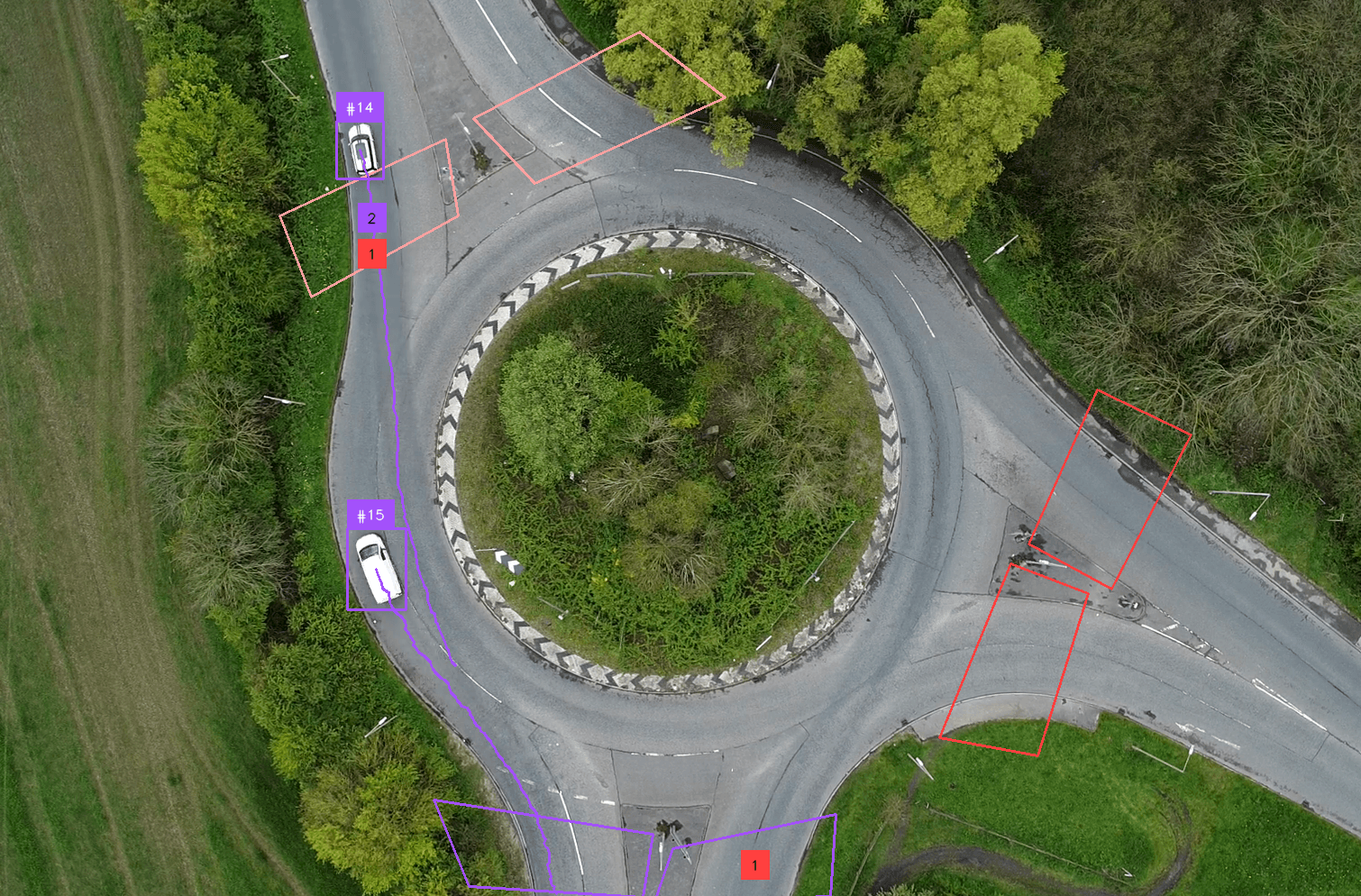

Traffic Insight — Aerial computer vision for junction usage.2025

Traffic Insight

Aerial computer vision for junction usage.

A traffic-aware vision system that detects and tracks how vehicles actually use a junction. Fine-tuned YOLO11 for aerial imagery, where vehicles are small, dense and rotationally arbitrary — the case off-the-shelf weights handle worst.

PyTorchOpenCVComputer visionTransport
Repository ↗
BusMONITOR — An embedded sensor suite for public transport.2022—2024

BusMONITOR

An embedded sensor suite for public transport.

Built from nothing: schematic capture, PCB design, C firmware on STM32, force-resistive seat-occupancy sensing, MQTT over cellular, a time-series backend and forecasting on top. Deployed on public transport vehicles to measure and predict passenger comfort.

STM32CPCB designMQTTDjangoPyTorch
Write-up ↗
2026

Relay

A remote-first media player for Android TV.

A native Android TV, Google TV and mobile player for IPTV services that use the Xtream Codes API. It ships no content and has no server of its own: it signs in to the user's own provider and turns very large catalogues into a fast, remote-friendly TV app with a live guide, a movie and series library, search and resume. Catalogues are streamed to disk and the XMLTV guide is parsed as it downloads, so huge playlists never run out of memory, and signed releases update themselves from GitHub.

KotlinJetpack ComposeAndroid TVMedia3 / ExoPlayerStreaming parsers
Releases ↗
NN-DS — Defending classifiers with epistemic uncertainty.2022

NN-DS

Defending classifiers with epistemic uncertainty.

A neural network built on Dempster–Shafer evidence theory that can label an input as uncertain instead of guessing. It needs no adversarial training and no warning that an attack is coming. Against DeepFool and JSMA perturbations on CSE-CIC-IDS2018 traffic, it cut misclassification of the two attacked malicious classes from 70.53% to 13.09% and from 99.67% to 1.33%.

PyTorchAdversarial MLEvidence theoryCSE-CIC-IDS2018
Information Fusion ↗
LR-DS — Feature selection by what the model doesn't know.2021

LR-DS

Feature selection by what the model doesn't know.

An evidential logistic regression that measures how much uncertainty each feature contributes, so an analyst can rank features from most to least ambiguous without cyber-threat expertise. Benchmarked against Decision Tree, Random Forest, Lasso and ANOVA across seven classifiers: F1 of 0.99 using, on average, under a third of the classification time.

PyTorchFeature selectionLogistic regressionNetwork security
Knowledge-Based Systems ↗

// 03Peer-reviewed

Two papers on what a model doesn't know

Both came out of the doctorate at Loughborough, and both rest on the same idea: a classifier that can quantify its own ignorance is more useful than one that is merely confident.

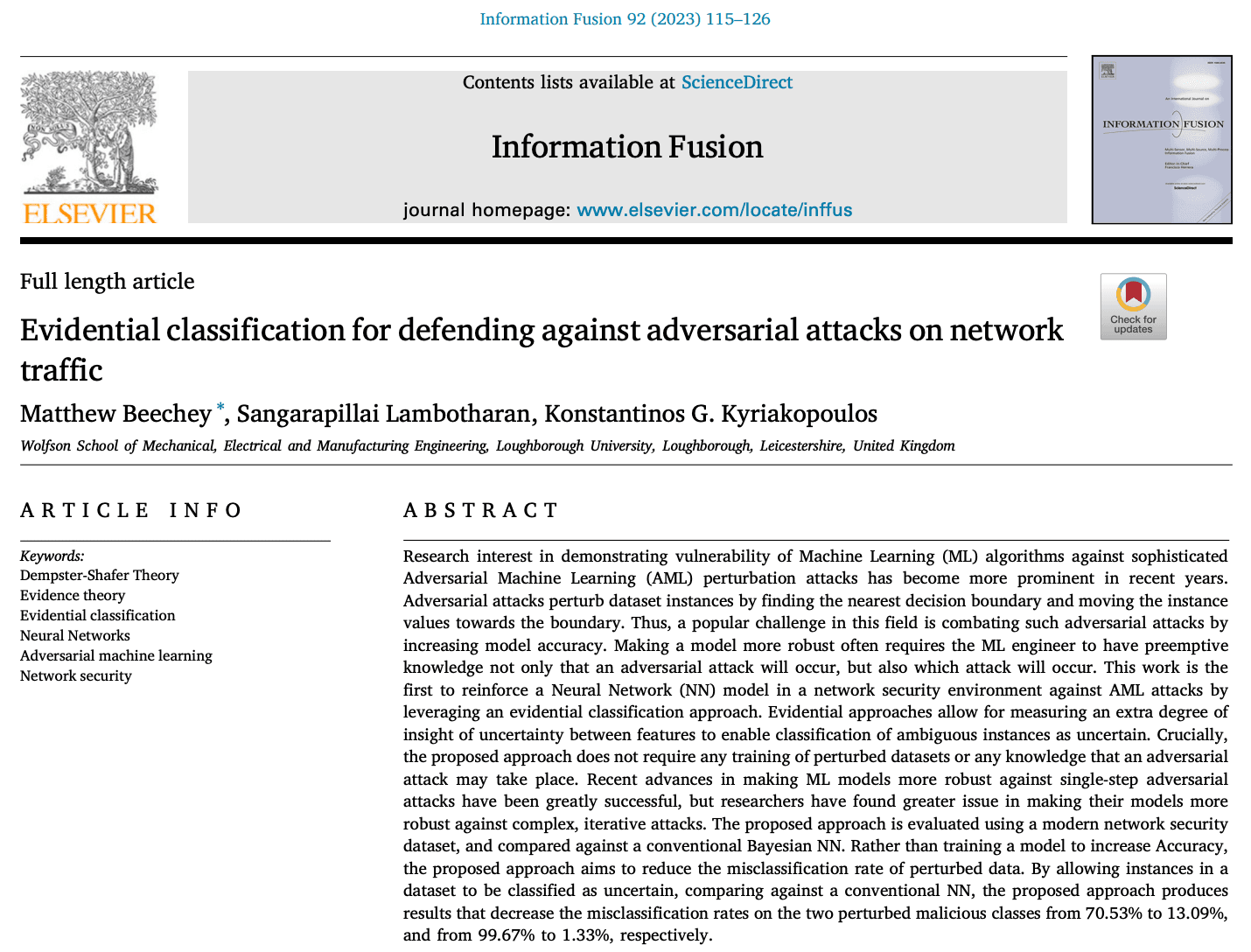
  1. [1]

    Evidential classification for defending against adversarial attacks on network traffic

    M. Beechey, S. Lambotharan, K. G. Kyriakopoulos

    The first work to harden a neural network against adversarial attacks in network security using evidential classification. Instead of chasing accuracy, the model is allowed to call ambiguous instances uncertain, with no training on perturbed data and no prior knowledge of the attack. Against DeepFool and JSMA, misclassification of the two perturbed malicious classes fell from 70.53% to 13.09% and from 99.67% to 1.33%.

    Information Fusion

    Vol. 92, pp. 115—126 · Open access

    2023

    read paper ↗
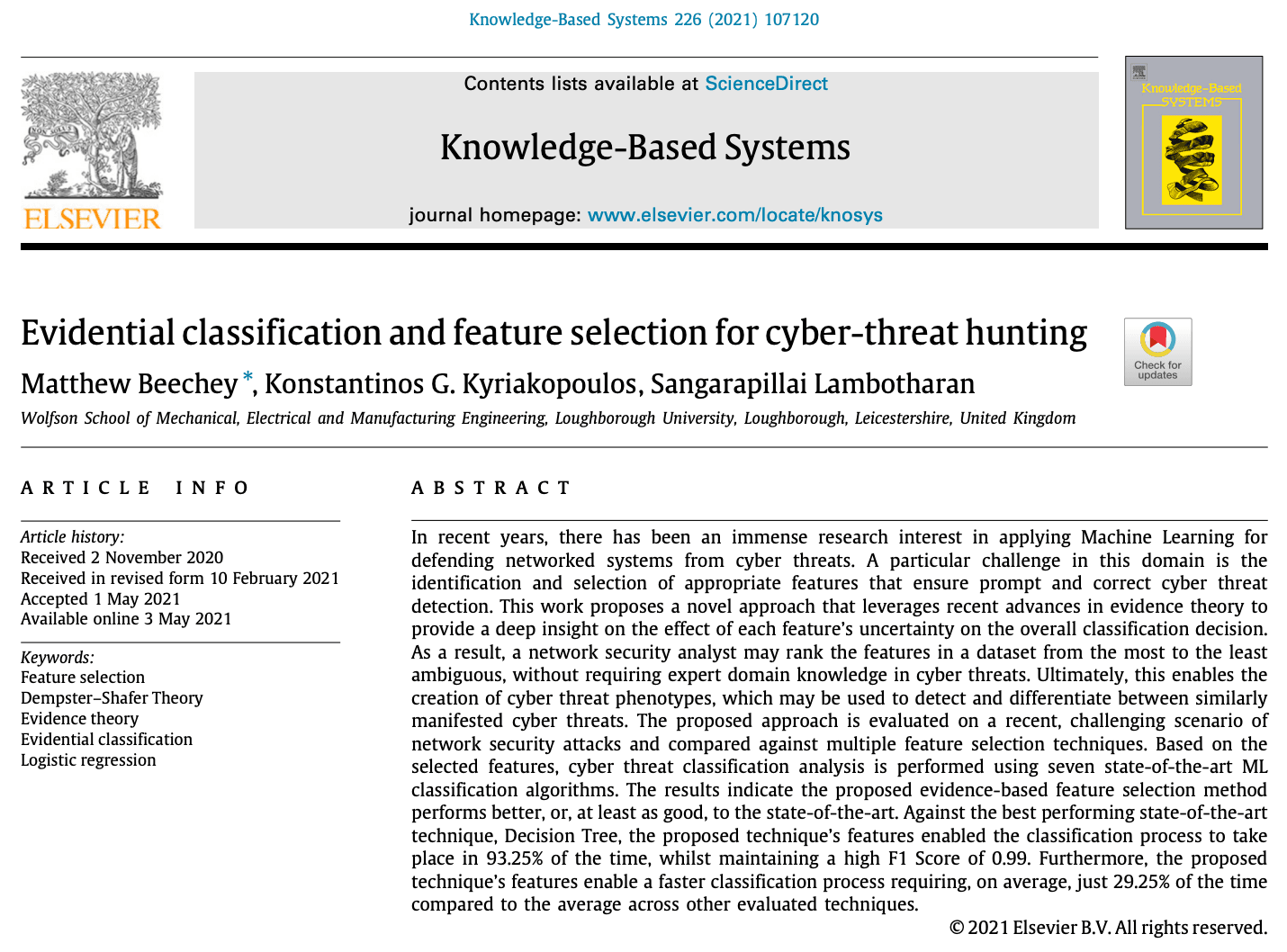
  2. [2]

    Evidential classification and feature selection for cyber-threat hunting

    M. Beechey, K. G. Kyriakopoulos, S. Lambotharan

    Evidence theory exposes how much each feature's uncertainty contributes to a classification decision, letting an analyst rank features from most to least ambiguous without cyber-threat expertise, and build threat phenotypes that tell similar attacks apart. The selected features matched or beat the state of the art across seven classifiers, reaching an F1 score of 0.99 while classifying in 29.25% of the average time of other techniques.

    Knowledge-Based Systems

    Vol. 226, 107120

    2021

    read paper ↗

Thesis: Evidence Theory Based Machine Learning Approaches for Network Security, Loughborough University, 2023 (open access). Further work on graph neural networks for beyond-5G networking is listed on LinkedIn.

// 04Career

Between the lab and the loading bay

Based in Loughborough, UK. The pattern alternates on purpose — research that had to ship, and shipping that needed research.

  1. 2025 — Present[industry]

    Lead AI Engineer @ TransHumanity

    • Lead the implementation of Aptiq, a multi-agent decision-intelligence platform for transport authorities and construction programmes.
    • Own the agent architecture, the ontology and structured query engine they reason over, and the provenance chain that makes every figure auditable.
    • Built the evaluation harness that scores agent quality against curated question sets before changes ship.
  2. Jun 2024 — 2025[academia]

    Machine Learning Researcher @ Loughborough University

    • Led the technical side of a graph neural network research project for beyond-5G networking.
    • Built a GNN that predicts latency across communication networks accurately enough to route segments on its output.
    • Developed a GNN for access-point user association, raising resource efficiency to defer hardware spend under user saturation.
  3. Apr 2022 — Apr 2024[industry]

    Technical Product Owner @ Vectare Ltd

    • Owned development of IoT sensor suites for public transport vehicles, from ideation to deployment.
    • Designed a model predicting dynamic private-hire vehicle costs, removing the human from the loop.
    • Schematic capture, PCB hardware design, C firmware, two-way comms, time-series database design and forecasting.
    • Worked directly with industry and government stakeholders; ran marketing and project reporting.
  4. Jan 2019 — Dec 2022[academia]

    Doctoral Researcher @ Loughborough University

    • Developed classification models for network security grounded in evidence theory.
    • Devised evidential defences against adversarial attacks that sharply reduced misclassification.
    • Invented feature-selection methods leveraging uncertainty, selecting optimal subsets on both accuracy and time to converge.
  5. Jan 2018 — Dec 2018[academia]

    Research Assistant @ Loughborough University

    • Benchmarked micro-clusters of embedded compute against high-power servers for rural web hosting and caching.
    • Formalised experimental results for conference publication.

Education

PhD2019—2022

Evidence Theory Based Machine Learning Approaches for Network Security

Loughborough University

MSc2017—2018

Internet Computing and Network Security

Loughborough University

Distinction

BSc2013—2016

Computer Science

De Montfort University

First Class Honours

// 05Toolkit

From PCB traces to transformers

Listed by what I have shipped with rather than what I have read about. A model is worth very little if nothing is measuring the world for it.

languages[]

PythonTypeScriptCSQLJavaPHP

machine_learning[]

PyTorchTorch Geometricscikit-learnPandasNumPySciPy

backend_web[]

DjangoFastAPIReactNext.jsPostgreSQLRedis

infrastructure[]

DockerAWS S3AWS EC2SageMakerGrafanaGit

embedded[]

STM32 ARM Cortex-MUARTI2CSPIADCMQTTGNSSCellular

hardware_product[]

KiCadAltium DesignerFusion 360Stakeholder engagementHorizon scanning

Alongside the technical work I have completed advanced training in leadership, strategic innovation and project management. Full detail is in the CV.

// 06Contact

Let's build something.

Open to conversations about applied machine learning, agentic systems and anything where a model has to answer to somebody.

The quickest route is email — write to mattbeechey@gmail.com, or use the form and it lands in the same inbox.

location:
Loughborough, UK
new_message.sh